



Members and the Sustainable Marketing Research Group jointly released the “Green Marketing Guidelines” presenting proactive guidance to transform the environmental value of green products and services into market creation
- On Apr 13, 2026
- Circular Economy, Corporate Sustainability, Environmental Strategy, ESG, Green Marketing, Greenwashing, Market Creation, Sustainability Communication, Sustainable business, Sustainable Marketing
Harch announces that it has jointly released the “Green Marketing Guidelines,” a set of guidelines and methods for effectively and attractively communicating green products and services to society, in collaboration with Members Co.,Ltd., which leads social transformation together with clients through on site DX support, and the Sustainable Marketing Research Group (*1).
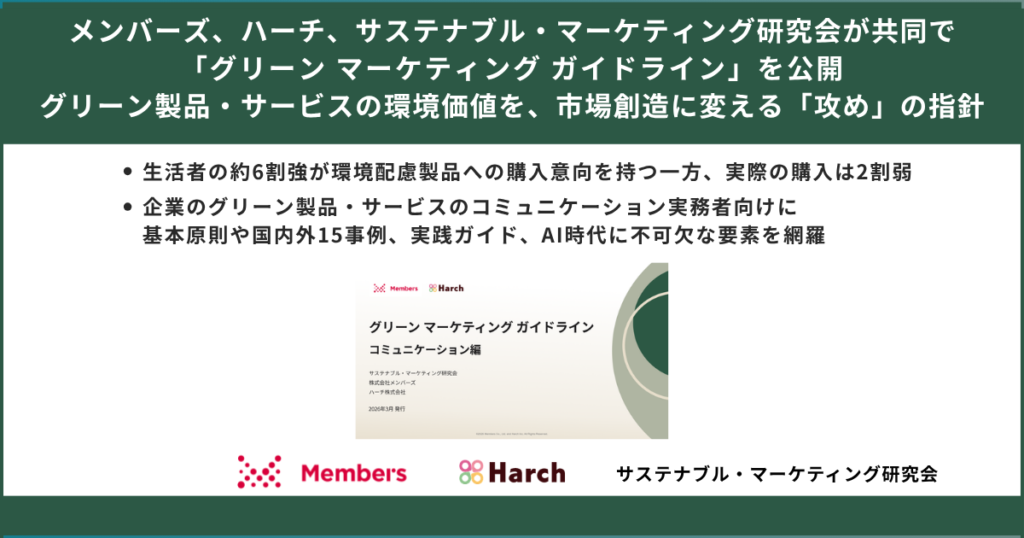
As environmental issues become increasingly severe, more than 60 percent of consumers express an intention to purchase environmentally friendly products, while actual purchases remain below 20 percent (*2). This guideline aims to remove the “information gap” between companies and society by addressing challenges such as difficulties in communicating cost related aspects and lack of expertise. It supports proactive communication and market creation for green products and services.
▶ Green Marketing Guidelines: Download here (in Japanese)
Features
- While existing guidelines focus on ESG, this guideline specifically targets communication for green products and services
- Beyond preventing greenwashing, it aims at marketing and market creation, covering fundamental principles for practitioners, domestic and international case studies, practical guides, and checklists
- It aims to realize a sustainable society by expanding green consumption through preventing greenwashing and promoting communication that builds empathy and trust
- Key elements for being selected by AI, such as consistency, transparency, and reliability, are also essential in communicating green products and services. These elements are comprehensively covered in the guideline
Target audience
All practitioners involved in communication related to green products and services, including business divisions, marketing, and sustainability departments, regardless of industry, business model, BtoB, or BtoC.
Main contents
Five basic principles
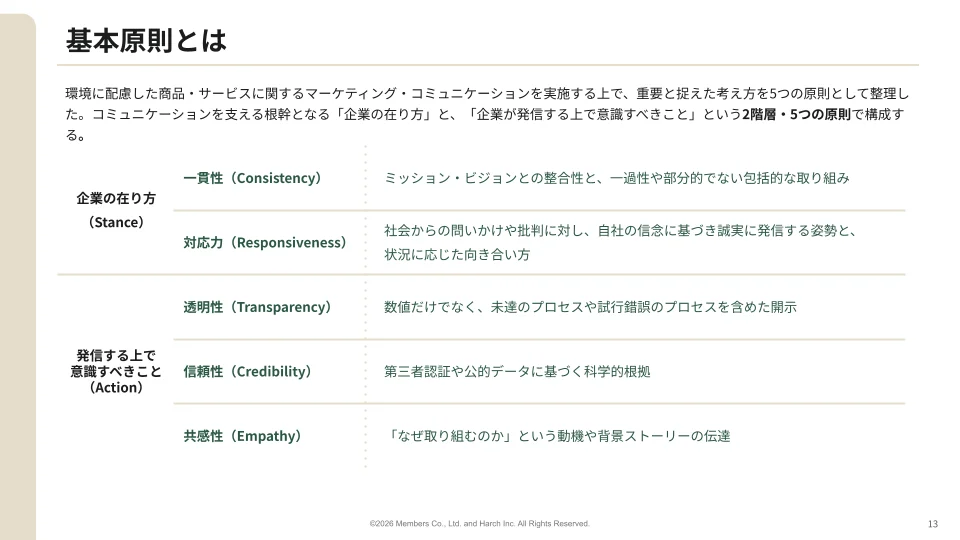
The key principles are organized into “how companies should be” and “what companies should consider when communicating,” with examples of practices to avoid and recommended approaches.
- How companies should be: consistency and responsiveness
- What to consider in communication: transparency, reliability, and empathy
Case studies from 15 companies in Japan and overseas
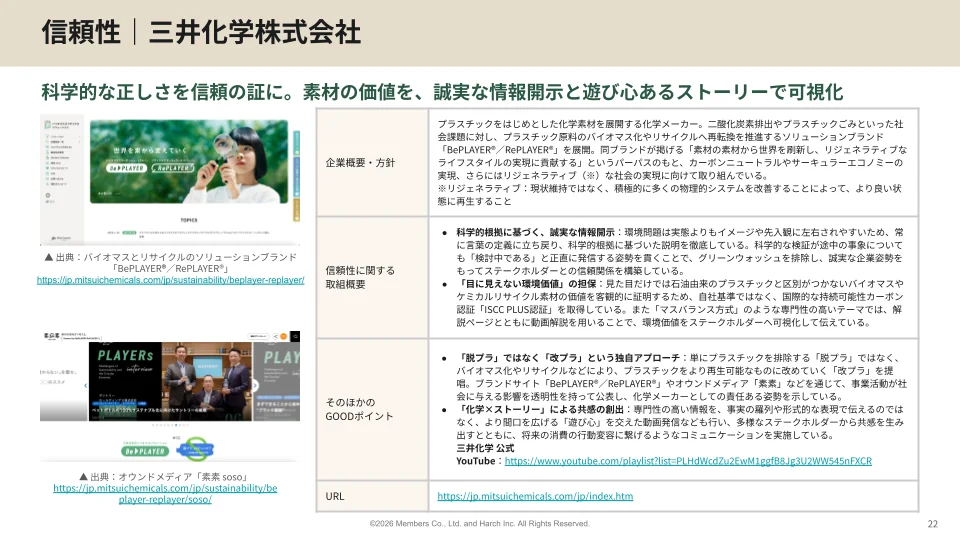
- Practical examples from domestic and international companies are introduced with key points
- Includes international examples that move beyond conventional communication models and aim to build new relationships through dialogue and other approaches
- Example companies
- Mitsui Chemicals, Inc.
- Fuji Oil Co., Ltd.
- Suntory Holdings Limited
- S.T. Corporation, among others
Practical guide
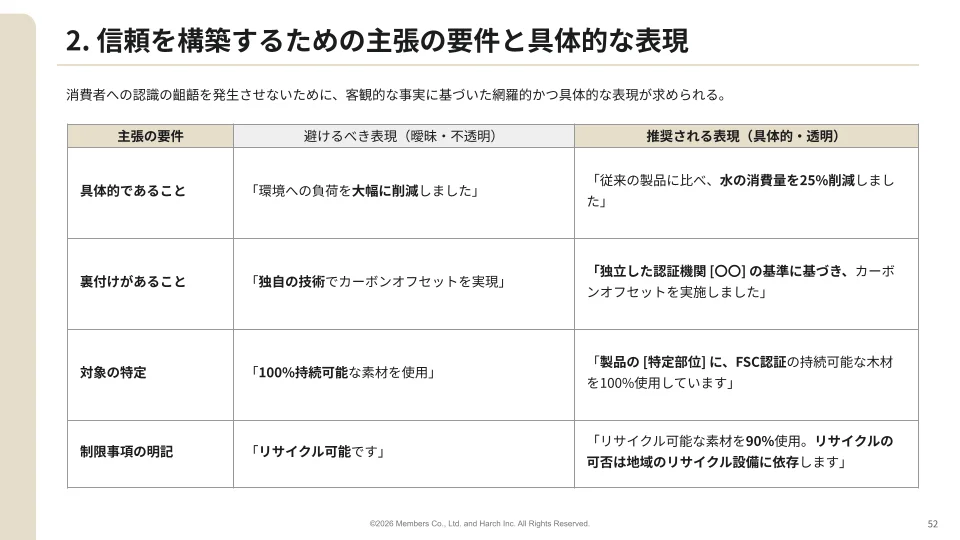
Examples and practical guidance are provided for five key areas.
- Patterns of greenwashing claims to avoid
- Requirements and expressions for claims that build trust
- Specific environmental claims and disclosure guidelines
- Risks and countermeasures related to greenhushing
- Communication strategies by channel
Background
Global environmental challenges such as climate change, resource depletion, and biodiversity loss are becoming increasingly severe. According to a survey by Members, more than 60 percent of consumers are interested in climate change and express purchase intent, indicating growing societal demand for environmentally conscious products and services. At the same time, companies face challenges such as difficulty in communicating cost implications, prioritization of short term sales, and lack of systems and expertise for communication. As a result, an “information gap” has emerged where corporate information does not sufficiently reach society, which is reflected in the low actual purchase rate of less than 20 percent.
In 2024, Japan Marketing Association updated its definition of marketing, explicitly stating that its role is to create value together with customers and society and to realize a sustainable society (*3). In response to these evolving demands, this guideline was developed in collaboration with the Sustainable Marketing Research Group, which promotes the social implementation of sustainable marketing in Japanese companies, and Members Co., Ltd., which leads social transformation together with clients through DX support. The guideline is publicly released to create an environment where companies can communicate with confidence and to promote proactive communication regarding green products and services.
*1: In this guideline, “green products and services” refer to products and services that contribute to reducing environmental impact across their lifecycle compared to conventional alternatives. This includes not only reductions in greenhouse gas emissions but also efficient use and circulation of resources, water conservation, and biodiversity considerations. In communication, it is important to ensure that emphasis on a specific environmental benefit does not obscure trade offs in other areas and that disclosure is made with integrity across the lifecycle.
*2: Based on Members Co., Ltd. “Consumer awareness survey on climate change and purchasing behavior (2024) (in Japanese)
*3: In 2024, Japan Marketing Association updated its definition of marketing as a concept and process for creating value together with customers and society, disseminating that value widely, fostering relationships with stakeholders, and realizing a more prosperous and sustainable society.
Details
https://harch.jp/news/green-marketing_202603.html (in Japanese)