


Event Report | Circular Business Design School Kyoto kicks off: Exploring Kyoto’s unique pathways to circularity
- On Dec 12, 2025
- Circular Business Design School Kyoto, circular design, Circular Economy, Community Design, Ecosystem Thinking, Edonomy, Kyoto, Learning Program, Local Industry, sustainability
Harch, commissioned by Kyoto City to operate the “FY2025 Circular Economy Foundation Development Program,” launched the Circular Business Design School Kyoto (CBDS Kyoto) in October 2025. On October 14, the kickoff event was held, marking the start of a learning program for local businesses with circular economy as its main theme. This article provides an overview of the event.
* This article is a republished report from IDEAS FOR GOOD, the web media operated by Harch that shares ideas for making society “better,” originally titled “What kind of future can Kyoto’s unique approach to ‘circulation’ create? Circular Business Design School Kyoto begins”.
What kind of future can Kyoto’s unique circularity create? Circular Business Design School Kyoto begins
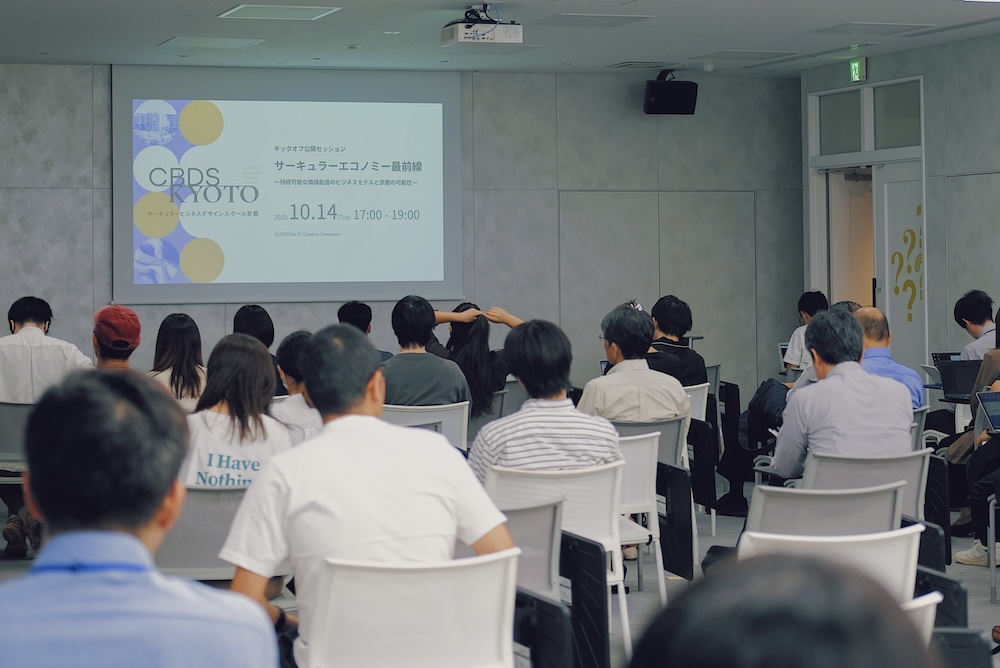
On October 14, 2025, the kickoff event for the Circular Business Design School Kyoto (hereafter, CBDS Kyoto) was held at QUESTION in Kyoto City.
CBDS Kyoto is a program designed to help participants learn about the circular economy and create circular business ideas within their own organizations and personal contexts. For FY2025, the program will run as a three month learning initiative, with the aim of producing prototypes that spark dialogue.
▶︎ Learn more about CBDS Kyoto: https://cbdskyoto.jp/ (in Japanese)
In addition to participants of the program, others who share interest in the circular economy also joined the event. Why is the circular economy so important now? What is the current landscape of circularity in Kyoto? This report shares what took place during the kickoff event.
Table of Contents
- The circular economy as an entry point for envisioning the future
- Why is the circular economy important now?
- Redesigning “relationships” inspired by ecosystems
- Reconnecting four forms of value: What we can learn from the Edo period
- Taking the first step toward a Kyoto style circular future
The circular economy as an entry point for envisioning the future
The event opened with remarks from Mr. Kimura of Kyoto City Environment and Energy Bureau, the organizer of CBDS Kyoto.
He shared:
“Kyoto City has positioned the promotion of the circular economy as a leading initiative. CBDS Kyoto is a core component of this effort.
We have often heard from businesses, ‘We are interested in the circular economy but do not know where to begin,’ or ‘It is difficult to collaborate with other companies.’ In response to these voices, we launched CBDS Kyoto as a co-creation program designed to foster new business models through knowledge sharing, prototype development, and networking.”
Mr. Kimura concluded by saying, “I sincerely hope that circular economy and circular business initiatives will spread from this program and from Kyoto.”
Why is the circular economy important now?
Next, Harch Inc. CEO Yu Kato, who oversees the design and operation of the program, delivered a keynote speech on the theme “Why is the circular economy necessary?”
He referenced the updated 2025 “Planetary Boundaries” framework, which shows that the Earth has already exceeded seven of nine critical thresholds. Despite this increasingly unstable situation, mass production and mass consumption continue, and global resource use is projected to double by 2060. This means that risks such as resource conflicts and economic instability are escalating.
The circular economy is gaining attention as a pathway forward. It shifts society away from a one way linear model of extraction, production, consumption, and disposal, toward one where products and systems are designed from the outset to eliminate waste.
However, Kato emphasized the importance of questioning whether circular initiatives truly reduce environmental impact. The concept of decoupling, which refers to separating economic growth from resource use and environmental degradation, is central to achieving meaningful circularity. He also highlighted the need to consider whether circularity contributes to social well being.
In 2024, ISO published the 59000 series, establishing global definitions and frameworks for the circular economy. As circular initiatives advance across Europe, Asia, and Africa, systemic transition supported by multi stakeholder collaboration will be essential.
Kato then posed a question to the audience:
“What is the most important value your company should deliver?”
For example, the aviation industry’s core value is “safety.” Yet as climate change intensifies turbulence, that very value is being threatened. Ensuring that companies can continue to deliver their essential value requires commitment to sustainability, a shift in perspective that becomes a driving force for circular transition.
As circular economy policies rapidly advance worldwide, and Japan’s own Basic Act for Establishing a Sound Material Cycle Society enters its fifth phase, a key question arises:
What unique forms of circularity can Kyoto create?
To explore this, two guest speakers joined the event: Mr. Suetsugu from Amita Holdings, and Mr. Kitabayashi from COS KYOTO.
Redesigning “relationships” inspired by ecosystems
Mr. Suetsugu of Amita Holdings shared his belief that sustainability must be rooted in learning from ecosystems.
He described three foundational principles:
- Metabolism: systems for exchanging materials and energy
- Relationships: interdependence rather than isolation
- Sustainability: passing forward what has been nurtured
He emphasized that the goal is not economic sustainability alone. Rather, it is the enrichment of social relationships and natural capital, with circularity serving as a means for achieving this.
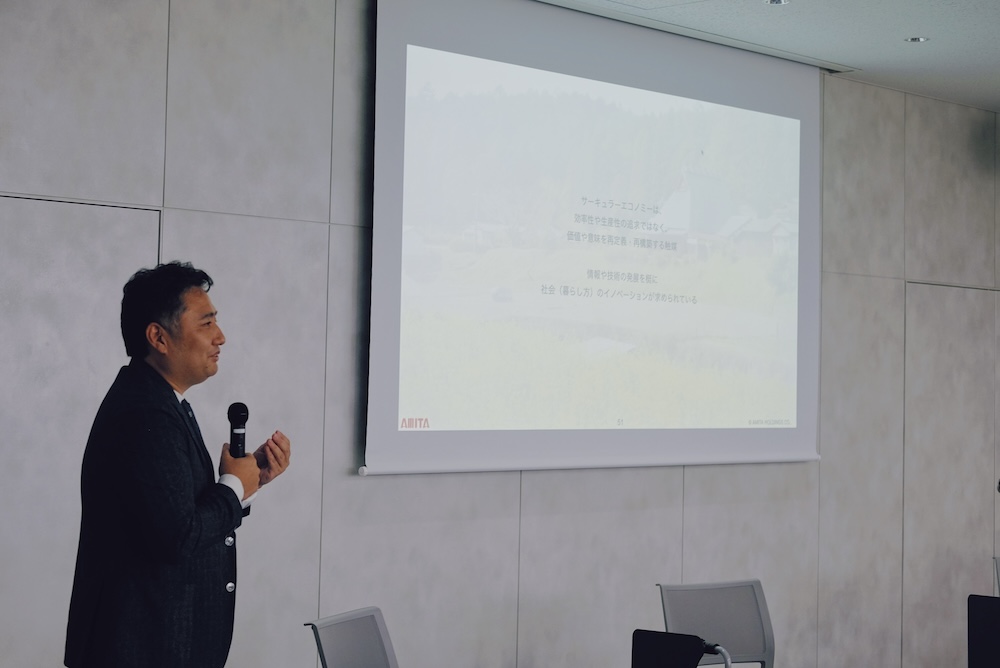
He offered a simple example: eggshells. “While many consider eggshells as waste, eggshells are 95 percent calcium carbonate and can serve as an alternative to natural limestone. Nothing is inherently waste; new value emerges by shifting perspective.”
Amita also focuses on designing community based resource circulation systems, where waste becomes a catalyst for community interaction.
“By bringing household waste to local resource stations rather than leaving it on the street, people meet, talk, and form connections that enrich life and contribute to disaster preparedness and community safety.”
He concluded by highlighting Kyoto’s unique potential:
“When thinking about Kyoto’s value, it is not only economic rationality but also the sensibilities and values cultivated throughout its history. Circularity in Kyoto must consider its unique sense of time, connecting past, present, and future.”
Reconnecting four forms of value: What we can learn from the Edo period
Mr. Kitabayashi of COS KYOTO then spoke about the roots of his work: witnessing the disappearance of crayfish and fish when rivers near his childhood home were encased in concrete. He emphasized that disconnection from nature is at the heart of environmental degradation.
He introduced the Italian concept of “territorio,” which views places not by administrative boundaries but by cultural identity. To understand industry in regions like Tango, he noted, one must look back to geological events from 15 million years ago.
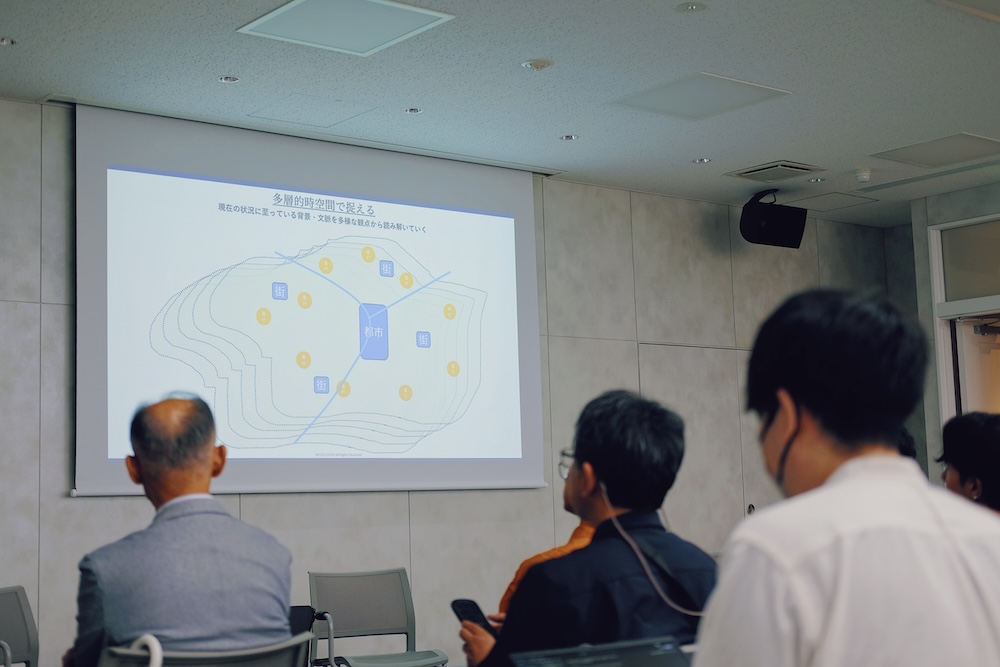
Multilayered time and space lenses reveal how land has transformed until today.
Building on this thinking, he introduced “Edonomy,” a model inspired by Edo period society where natural resource cycles, commons, culture, and economy were intertwined. Modern society has fragmented these elements, and he emphasized the importance of reconnecting them.
He shared a story of inviting Milan based designers to the Tango region. Rather than showing only the textile technologies, the experience emphasized nature, culture, and daily life. As a result, the designers deeply resonated with the region and independently proposed how to exhibit their work at Milan Design Week.
This showed that value lies not only in functional features but also in where meaning is placed, an idea that connects strongly to the Edo period’s resource conscious lifestyle.
Taking the first step toward a Kyoto style circular future
The final cross talk explored what a “Kyoto style circular economy” could look like.
Mr. Suetsugu spoke about integrating three perspectives from tea ceremony, namely manner, space, and tools, into corporate culture, spatial design, and product or service development.
Mr. Kitabayashi reflected on the origin of the word “kudaranai,” noting that Kyoto once spread high quality culture across Japan. He expressed a desire to once again share something meaningful from Kyoto with the world.
Circularity is found in the “in between,” the relationships between people, between people and nature, and within culture, history, and place. Reweaving these connections, while reinterpreting them with modern technology and global trends, will be key to shaping the circular society ahead.
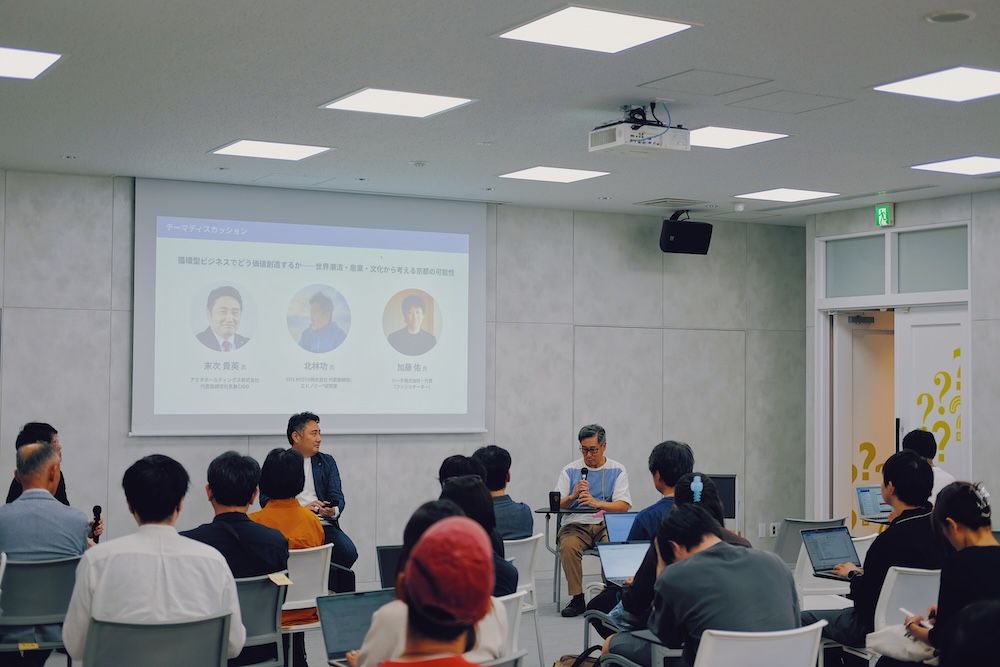
Mr. Suetsugu commented that successful circular economy cases are characterized by crossing boundaries and strong collaboration:
“Whether this becomes a positive connection or not depends on our awareness and actions.”
Mr. Kitabayashi added:
“I want us to take the first step toward a society we can be proud of one thousand years from now.”
This kickoff event raised questions about what Kyoto’s circular future could look like, one filled with possibilities that go beyond material circulation. Expectations are growing for what CBDS Kyoto will create.
Three months of learning begin here
After the public event, the first session of the three month program began with participants and mentors. Participants reviewed the upcoming schedule, introduced themselves, and prepared for the final presentation planned for January 2026.
The second and third sessions will involve fieldwork in Kyoto City and Keihoku, examining why circularity is necessary through the lens of local culture and practice.
IDEAS FOR GOOD will continue sharing updates on CBDS Kyoto. Stay tuned.
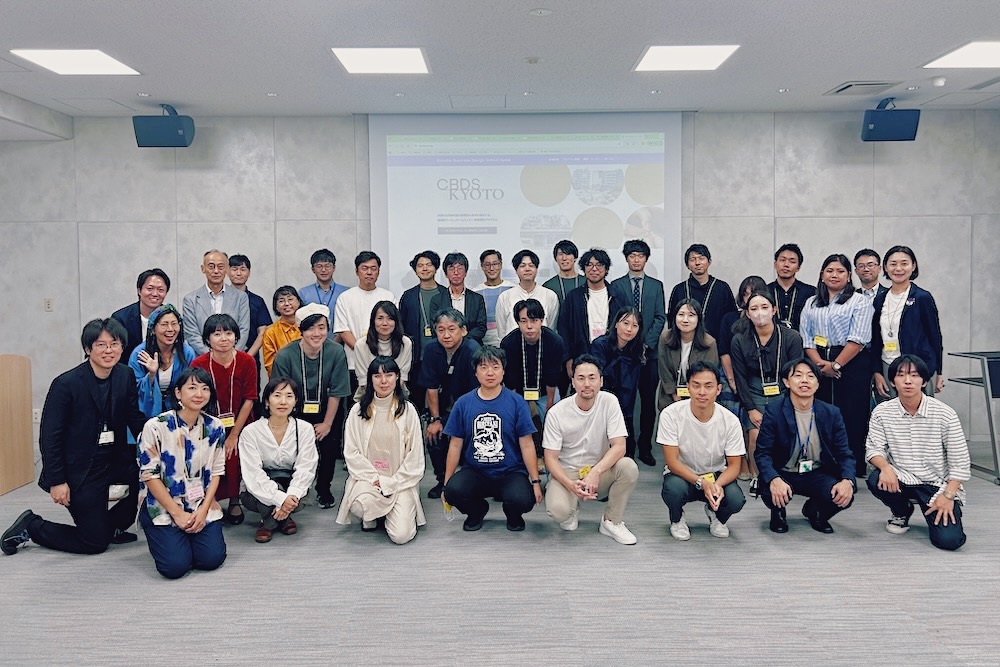
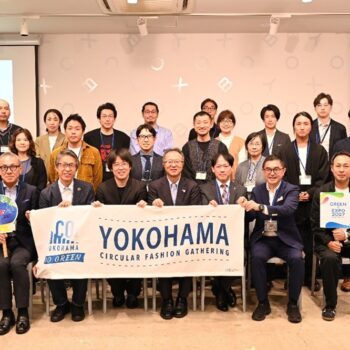
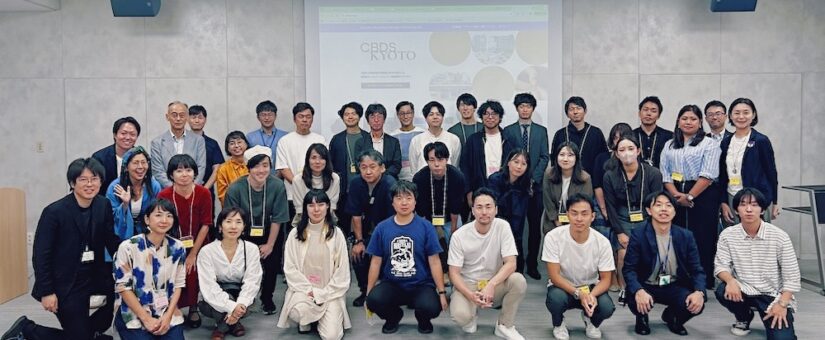
Participants and mentors

Package free sweets and flavored tea served by Totoya, a zero waste store in Kyoto
About Circular Business Design School Kyoto
Kyoto has assets cultivated over 1,200 years, such as the spirit of “shimatsu no kokoro” (frugality), circular ways of living, and craftsmanship traditions that continue to shine across generations.
To create the circular future now demanded by global challenges like climate change and biodiversity loss, it is essential to harness this wisdom and apply it to the present with creativity.
Harch has launched the Circular Business Design School Kyoto in October 2025, a learning program that combines Kyoto’s heritage of circular wisdom with cutting-edge insights in circular economy to co-create the desired future.
Decode Culture, Design Future: Unravel wisdom and design innovation. Together from Kyoto, let us envision a circular future that extends beyond tradition.
【Related Articles】IDEAS FOR GOOD “Kyoto’s 1200 year history holds clues to the circular economy: A vision for a future where environment and industry coexist” (in Japanese)
【Related Articles】IDEAS FOR GOOD “Special Dialogue: Exploring the future of Kyoto-style circularity with Akihiro Yasui” (in Japanese)