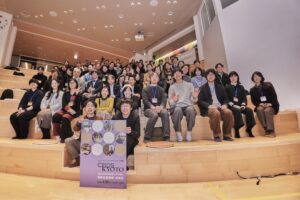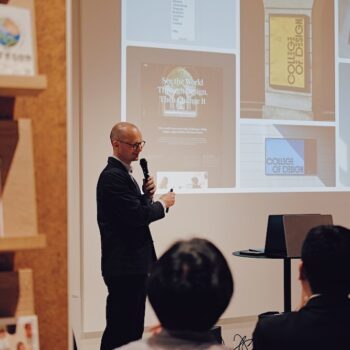



Circular Economy Hub held Refuturing “Architecture: From materials to indicators. The challenges and possibilities of circular architecture from Japan’s advanced cases and practices”
- On Jun 22, 2026
- Building as Material Bank, Circular Architecture, circular design, Circular Economy, Construction, Madaster, Material Passport, Nikken Sekkei, Refuturing, Taisei Corporation
Circular Economy Hub, operated by Harch, has rebranded its monthly online learning program “Circular X,” which explores future visions of the circular economy across industries and fields, as “Refuturing.” The program has launched as a new series and continues to be held monthly as a space for dialogue to reimagine the future.
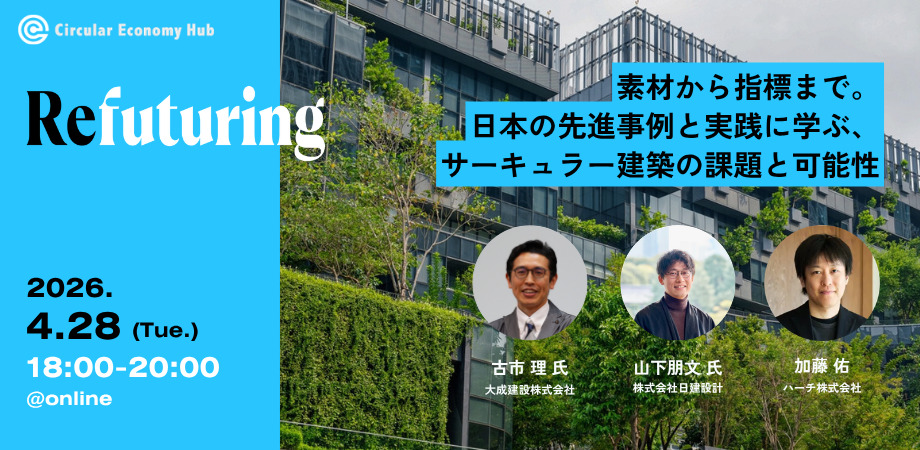
The theme for April was Refuturing “Architecture: From materials to indicators. The challenges and possibilities of circular architecture from Japan’s advanced cases and practices.”
Refuturing: Architecture: From materials to indicators. The challenges and possibilities of circular architecture from Japan’s advanced cases and practices
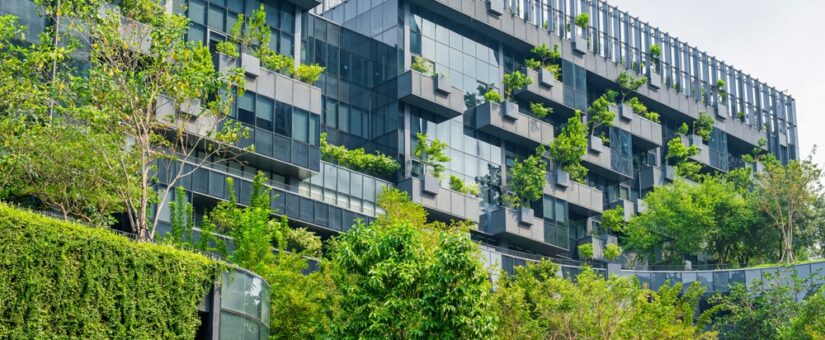
The construction and architecture industry is indispensable to our daily lives, yet it accounts for approximately 37% of global CO2 emissions, roughly 50% of all raw material extraction, and generates approximately 30–40% of all waste through construction and demolition activities. Furthermore, global building floor area is projected to double by 2060, which is a pace equivalent to building an entire Paris every week, a New York every month, and an area equivalent to the total landmass of Japan every year.
Beyond conventional construction recycling focused primarily on downcycling, the construction and architecture sector has been embracing a wide range of circular design practices aimed at decoupling resource consumption from the value of buildings and spaces. These include design for disassembly, enhanced material durability, and the use of reused, recycled, and renewable materials. In recent years, the concept of “Buildings as Material Bank”; treating buildings as temporary reservoirs of resources that can be disassembled and their materials recovered and reused at end of life, has gained increasing traction, alongside the adoption of Material Passports and the development of circular performance indicators for buildings.
Guests included Osamu Furuichi of TAISEI CORPORATION, who has been advancing circular design in architecture through the Madaster material passport platform and the zero-carbon building “T-FIELD/SATTE” (reference article: Circular Economy Hub “Circular design linking digital and material. Taisei Corporation’s vision for circular construction in Japan“), and Tomofumi Yamashita of NIKKEN SEKKEI LTD who promotes circular design through the Circular Design Collective initiative.
Furuichi has been working to introduce the Madaster platform to the Japanese construction industry in partnership with TAISEI CORPORATION, exploring how Material Passports can enable the practical realization of Buildings as Material Bank in Japan (partnership announcement). His work on T-FIELD/SATTE, a zero-carbon building in Satte City, Saitama Prefecture, demonstrates how circular design principles can be embedded from the earliest stages of a project.
Yamashita, after studying at the Royal Danish Academy during his graduate studies and gaining practical experience in the research and development division of circular architecture startup Lendager, has been advancing the adaptive reuse of existing building stock and material circulation at NIKKEN SEKKEI. Through the Circular Design Collective and the Circular Idea Catalog, he bridges planning, design, and research to drive circular practices forward.
With these two guests, who are at the forefront of circular architecture in Japan, the session examined the challenges and possibilities of circular architecture, from materials and indicators to systemic approaches to urban design, and explored visions for a circular future in which the built environment serves not as a source of waste, but as a continuously regenerating reservoir of materials for generations to come.
About the Refuturing event series
A monthly event series developed by Circular Economy Hub. The series invites thought leaders and practitioners who are driving the transition toward a sustainable circular future, exploring new ways of circular design that question linear growth narratives from diverse perspectives and reweave relationships between humans and nature, as well as between the present and the future.
* What is Refuturing? As challenges such as climate change and resource constraints intensify, there is growing concern that current social systems may be limiting the possibilities of future generations. This situation is sometimes described as “Defuturing.” Refuturing refers to a way of thinking and practice that questions the underlying assumptions of existing economic and social systems, institutions, and values that diminish the future, while repairing relationships between people and the world and reconstructing alternative and more desirable futures.
Organizer: Circular Economy Hub
Circular Economy Hub is a specialized media platform on the circular economy operated by Harch. It provides the latest trends, case studies, insights, events, and workshops related to the circular economy both in Japan and globally. Through the expertise of its editorial team located in Japan and around the world, as well as its networks and practical experience, it supports companies and municipalities in advancing circular design, circular business, and the transition to circular cities.
URL: https://cehub.jp (in Japanese)
Support for circular city transition for municipalities by Circular Economy Hub
- Circular City Transition Guide: Circular city transition guide (in Japanese)
- Circular City Transition Indicator: Circular city transition indicator (in Japanese)
For more information
https://cehub.jp/event/refuturing-3/ (in Japanese)
![[IDEAS FOR GOOD] Event report | How Denmark's Kontrapunkt defines](https://harch.jp/wp-content/uploads/2026/05/ideas4good_kontrapunkt_202605-300x200.jpg)